Tuesday, March 18, 2014

Native American Image in Children’s Literature

Presently, discussions continue to occur about Native American image in the United States and Canada. These include how Native American Indians/Alaska Natives are represented and portrayed in film*, as sport mascots, and in literature.

If you are the parent of young child, or a K-12 educator, perhaps you have been concerned about how Native American Indians/Alaska Natives are presented in some children’s books. Perhaps you been concerned about the consequences of inadequate representation in some these purportedly educational resources. If so, you may be interested to learn about the American Indians in Children’s Literature (AICL) organization and the resources it provides.

Established in 2006 and operated today by Debbie Reese (Nambe Pueblo), the AICL provides critical perspectives and analysis of indigenous peoples in children's and young adult books, the school curriculum, popular culture, and society. The AICL operates a user-friendly website that allows the public to search for book reviews, learn about Native media, and more. For many, the AICL offers an important resource toward helping our schools and communities improve.

The AICL’s website can be accessed here; http://americanindiansinchildrensliterature.blogspot.com/


* For those interested in a good educational program about Native American image in film see Reel Injun (2011). Website here; http://www.reelinjunthemovie.com/site/


Sealaska Heritage Institute was founded in 1980 to promote cultural diversity and cross-cultural understanding. The institute is governed by a Board of Trustees and guided by a Council of Traditional Scholars. Its mission is to perpetuate and enhance Tlingit, Haida, and Tsimshian cultures of Southeast Alaska.

Thursday, March 6, 2014

Tináa Art Auction a big success

By Amy Fletcher

Juneau Empire - Feb. 3, 2014
The artwork on view at Saturday night’s Tináa Art Auction at Centennial Hall highlighted the vibrancy and range of what’s been happening recently in the world of Northwest Coast art, while paving the way for a project that will help carry that energy forward into the future.
Tináa, Sealaska Heritage Institute’s first-ever art auction, drew a sold-out, black-tie crowd of more than 300 people, who collectively raised more than $300,000 for the Walter Soboleff Center, currently under construction on Front Street downtown. The building, named for a highly influential Tlingit elder and spiritual leader who died in 2011 at age 102, will house an array of art programs, as well as performance and exhibit spaces and a retail shop.
Excitement about the new building, and for the quality of the work on display, was very much in evidence at Saturday night’s high-energy event, which combined aspects of a museum opening, a gourmet dinner, a runway fashion show and a high-end art auction. Auctioneer David Karp of Nome kept the tone playful and personal, calling to audience members by name as he shepherded the crowd through the 13 live auction items. A silent auction featured nearly 40 additional pieces, from jewelry to basketry to sculpture.
Many of the internationally celebrated artists who donated works to the auction were in attendance, and several took turns at the microphone to share their enthusiasm for the Soboleff Center and for the man himself. Among them were David Boxley, a Tsimshian carver whose bentwood chest was among the largest items in the live auction, and Haida artist Robert Davidson, who donated another major piece, a black and red painting called “Greatest Echo.” Another big-ticket item in the auction was a rare 14-foot spruce river canoe carved by Tlingit artist Fred Bemis of Yakutat, so light that it requires ballast when operated by only one person.
The live auction also featured work by Nicholas Galanin, Preston Singletary, Steve Brown, Chloe French, Louise Kadinger, Duane Bosch, TJ Young, Delores Churchill, David R. Boxley and Sonya Kelliher-Combs.
Prior to the auction, a runway show of innovative Northwest Coast fashion was presented to whistles and cheers from the audience. Among the items on view was a salmon skin dress created from 35 Kenai river salmon and a luxurious coat made from sea otter fur (sea otters have the densest fur of any animal, with up to 1 million hairs per square inch). Designers who participated in the fashion show were Janice Jackson, Kandi McGilton, Ricky Tagaban, Brenda Lee Asp, Joel Isaak, Marcus Gho, Shaadoo’tlaa.Gunaaxoo’Kwaan and Louise Kadinger.
The title of the event, Tináa, is a Tlingit word that refers to a traditional copper shield representing wealth and trade. In planning the auction, SHI drew on longterm research of the Sante Fe Indian Market, an annual event held since 1922 that draws more than 150,000 people to Sante Fe, N.M., every August.
A beaming Rosita Worl, addressing the crowd at the end of the evening, said she sometimes hears that Juneau is a divided community, but that the outpouring of support for the Soboleff building from so many individuals and businesses has been an overwhelmingly positive example of how we can work together for a common goal of creating a regional hub in Juneau for Northwest Coast art.
“We are going to make this the Northwest Coast art capital of the world,” Worl said.

Wednesday, January 8, 2014

Alaska State Historical Records Advisory Board seeks to send professional archivists to communities

SHI’s archivist, Zach Jones, is participating in a state program to offer consulting services to organizations with archives. Applicants can request that the Alaska State Historical Records Advisory Board (ASHRAB) send a professional archivist to their community to give two to three days of hands-on service. This includes help processing collections, training staff, preserving collections, helping with policy development, and offering a planning and preservation survey. No charge. SHI is hoping to serve Southeast Alaska tribal organizations. More: http://archives.alaska.gov/pdfs/ashrab/ConsultingArchivistsProgram01_06_2014.pdf

Emergence of rare Tlingit war helmet raises a chorus for homecoming

Anchorage Daily  News
By Laurel Andrews January 7, 2014

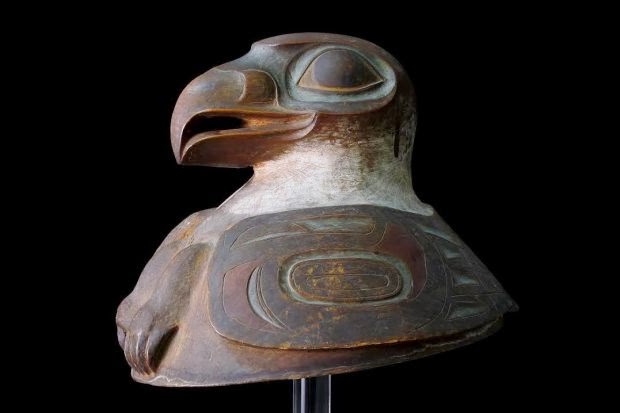
Tribal leaders are hoping a rare Tlingit war helmet that sat mislabeled in museum archives in western Massachusetts for more than 100 years will be returned to Southeast Alaska now that the artifact, considered a sacred object, has been brought to light.
The helmet, uncovered this autumn in the Springfield Science Museum archives, was put on display in late December. Records show that the object was accepted into the museum’s collections around the turn of the 20th century, spokesperson Matt Longhi said. The helmet was logged into museum archives simply, and incorrectly, as “Aleutian hat.”
But after scrutiny by curator of anthropology Dr. Ellen Savulis, and with coordination with the Alaska State Museum, the helmet was quickly identified as a rare Tlingit war helmet.
The helmet is one of less than 100 known in existence today, said Alaska State Museum curator of collections Steve Henrikson. It’s likely from the early to mid-1800s, and was intended for use in battle by Tlingit warriors. Only three or four of those helmets remain in Alaska today, Henrikson said.
In 2008, a similar helmet sold at auction for more than $2 million. But its monetary value is of little matter to either the museum or the Tlingit people.
Sealaska Heritage Institute vice chair Rosita Worl described the war helmet as an at.óowu -- meaning “an object that was owned by a clan and holds the Spirit of the Eagle. It embodies the spirit of our ancestors” who created and used the hat. Worl wrote in an email that “its emergence signifies that the ancestral spirits want and need to come home.”
“I would trust the Springfield Museum will understand that the sacred value of this hat lies in its return to its home,” Worl wrote.
The belief that the object is calling to be returned home is shared by other Tlingit people, as well. Leona Santiago, admiral for the yaanwhasshaans (women of the Kaagwaantaan clan), said she feels “it’s a really positive change in terms of our ancestors letting us know that they’re still here.”
“People are excited about the re-emergence of this one,” Santiago said.

Uniqueness complicates the process

The Springfield Science Museum has begun the repatriation notification process, sending letters to thirty Alaska tribal organizations notifying them of the helmet’s existence. The museum is also including a list of all items in their archives identified as being from Southeast Alaska, in case tribes want to make further repatriation claims -- a step beyond the federal mandate, Longhi said.
The Central Council of Tlingit & Haida Indian Tribes of Alaska has already started the repatriation process on the helmet, President Edward Thomas confirmed on Tuesday. Founded in 1935, the Tlingit Haida Central Council is a federally recognized regional tribe in Southeast Alaska. Folks who are aware of the object's existence are excited about it, Thomas said.
However, the uniqueness of this object may present an additional challenge for the council.
Most objects are associated with a clan, not a moiety (either the Eagle or Raven moiety, in Tlingit-Haida lineage). Since the helmet appears to belongs to the Eagle moiety, “we want to be careful” not to offend any involved parties, and will take some broad discussions to determine where the helmet will end up if brought back to Alaska.
Henrikson said Tuesday that while the bird appears to depict a bald eagle, it could be some other bird or even a supernatural creature -- which would also affect the question of ownership.
For now, though, the Tlingit Haida Central Council is moving forward with the idea that the helmet belongs to the Eagle moiety and not an individual clan. No clans have yet come forward to claim the helmet as their own, Thomas said.
The council is also working with the Southeast Alaska Native Veterans Association to gather input on the future of the object, as it was once intended for battle.
“I would like to see it be used ceremoniously with the veterans group,” Thomas said, whose members are “so very interested and active” in advocating on behalf of veterans.
Thomas said he is confident that the object will be brought back to Alaska. He hopes it will be stored in the new Sealaska Heritage Institute building slated for construction in Juneau because it will offer climate-controlled conditions for the priceless artifact.

NAGPRA process: 'Intense'

The object would be brought home under the auspices of the Native American Graves Protection and Repatriation Act (NAGPRA), a federal law passed in 1990 which provides a process for museums and federal agencies to return certain cultural items.
The process can be daunting, however, especially for folks living in remote areas, short on time and resources.
The repatriation process is “intense,” said Dr. Bambi Krauss, president of the National Association of Tribal Historic Preservation Officers in Washington, D.C., a nonprofit organization of tribal government officials who implement federal and tribal preservation laws. Cases average around three years, but can take longer, she said.
“A lot of villages don’t have the resources to hire someone to go through the process, so it’s very frustrating,” Krauss said. And grant money is limited -- museums and tribes must compete for the same federal grants from the National Park Service.
Federal agencies have also come under scrutiny for not fully implementing NAGPRA. Two reports issued by the Government Accountability Office, one in 2010 and the other in 2011, outlined shortcomings by both the Smithsonian Institute and Federal agencies in complying with the act.
However, at least the initial steps are relatively straightforward, said John F. C. Johnson, vice president of cultural resources for the Chugach Alaska Corporation. Johnson has helped to repatriate objects to Chugach tribes for more than 20 years. A federally recognized tribe sends a letter to a museum, stating in broad terms what its purpose is, and what it is searching for. Under NAGPRA, museums are mandated to send back an inventory of all items in their collection that hail from a particular region.
Then the longer process begins. A tribe will make its case to the museum, providing evidence that a certain object belongs to them. The museum makes the final call on whether to return the object. After that, an appeals process through the National Park Service is available if disputes remain.
Johnson urged tribes to designate a tribal liaison to take charge of repatriation, who can take the lead in the process.
Repatriation law falls only within the borders of the United States -- There’s no law to provide for the return of objects that are bought and sold across international lines. Sometimes objects are returned with the help of organizations. Such was the case in December 2013, when the Annenberg Foundation purchased more than $500,000 worth of Hopi and Apache artifacts at a Paris auction.

Part of the bigger picture

Repatriation is seen as part of a larger movement of cultural preservation to bring traditional Alaska Native culture to the forefront of people’s minds.
“If some big part of the puzzle was broken, it’s your obligation to make it whole again,” Johnson said.
Ancestral objects are “your identity, your heritage,” Johnson said. Bringing these sacred objects back to Alaska helps to unite a tribe, and bring younger generations closer to their ancestral history, Johnson said. He pointed to other measures, such as the Nuuciq Spirit Camp in Prince William Sound, a 3-week camp where elders and youth come together to explore language, traditional arts and culture. It’s a way to unite the young and old, he said.
One of the Chugach tribes’ top priorities are the return of human remains and funerary objects, many of which were excavated by archeologists around the turn of the 20th century. Native Alaskans want those remains to come home. “Reverence for human remains is embedded in everyone,” Johnson said.
In the early 1900s, both grave robbers and members of the scientific community pulled up hundreds of thousands of Native American graves. Today, in museums across the country, more than 120,000 Native American human remains are still sitting in collections -- the vast majority of which are listed as “culturally unidentifiable.”
The attitude of the scientific community has changed immensely since the early 1900s, and now there’s far more cooperation between tribes and museums. Today, these parties “work together for the betterment of everyone,” Johnson said.
Contact Laurel Andrews at laurel(at)alaskadispatch.com. Follow her on Twitter @Laurel_Andrews

Tuesday, November 26, 2013

Worl says shamanism still influential in Tlingit culture today

By Casey Kelly
Posted on November 18, 2013 at 5:54 pm
Category: Alaska Native CultureCommunityFeatured News,Spirit
Estimated reading time: 3 minutes, 12 seconds
The Tlingit people of Southeast Alaska no longer practice shamanism, but elements of it still exist in their culture today.
That’s according to Anthropologist
and Sealaska Heritage Institute President Rosita Worl, who spoke Monday as part of SHI’s Native American History Month Lecture Series.
Worl says shamanism used to be a major component of Tlingit life. She says every clan had a shaman before Russian and American colonization largely forced the Tlingit people to abandon their traditional religion.
“Shamanism is generally associated with hunting, fishing and gathering societies that often migrate with seasons to follow their food sources,” says Worl. “To bring food, health and protection from evil, shaman seek connections with animal powers through their rituals.”
Worl says the shaman’s responsibilities included maintaining the well-being of the clan; acting as a military advisor; assuring hunting and fishing success; predicting future events; and curing illnesses. To do that they performed rituals designed to ward off hostile and dangerous spirits, and call upon good spirits to support the clans’ welfare.
Worl says Tlingits believed that great shaman traveled in both the physical and spiritual world, and that spirits chose certain people to be shaman.
“The majority of spirits with which the shaman makes his alliances are animals, animal spirits,” she says. “This reflects a widespread belief by cultures that practice shamanism that animals inhabited the world long before human beings and are essential to people because of the unique knowledge that animals possess.”
She says Tlingit clans last practiced traditional shamanism in the 1950s, but she argues it still pervades the rituals and beliefs of Southeast Alaska Natives today. For instance, Worl says Tlingits – including the late-Reverend Dr. Walter Soboleff – still believe that all objects possess some sort of spiritual essence.
“I’ve had meetings here in this room, where people like our spiritual leader, Dr. Soboleff, has pounded on the table and says, ‘Everything has a spirit! Even this table has a spirit!’” Worl says, pounding her own fist on the podium.
About 15 years ago at a clan conference organized by the heritage institute, Worl says several elders attributed modern social problems, such as alcoholism and suicide, to Tlingit societies being out of balance.
“In our society we have a number of practices to ensure both social and spiritual balance, and they were holding that we were out of spiritual and social balance, and this was the cause of the social illnesses that affect our society,” Worl says.
She says that discussion led to some of SHI’s most successful cultural programs.
Worl says the influence of shamanism on modern Tlingit life is perhaps most evident in the use of sacred objects and regalia in ceremonial acts, including memorial celebrations.
“When our ceremonial and sacred objects are brought out and the spirits are addressed or called upon in the same way as they were in earlier times,” she says.
Worl says many Tlingit elders are reluctant to discuss shamanism, perhaps due to the punishment Native people endured at the hands of colonizers for practicing their religion.
She says its unlikely traditional shamanism will ever be completely revitalized, but some Tlingits are looking at ways to incorporate more of the old practices in modern ceremonies.
The next talk in SHI’s Native American History Month Lecture Series happens Tuesday at noon. Professor Alan Boras of Kenai Peninsula College gives a lecture on “Salmon and Indigenized Orthodoxy on the Nushagak River.” The theme of this year’s series is Native spirituality.

View the full lecture online by clicking here.